Accountancy
Level 3 Diploma in Accountancy (60 Credits)
Ofqual Regulated (603/3811/8) | Awarding Body: OTHM
Study Mode: Online | Start: Anytime | Pace: Flexible
Assessment: Online written assignments
Includes: 1-to-1 tutor support, course materials, webinars, social learning forum
Course Overview
The OTHM Level 3 Diploma in Accountancy (equivalent to one A Level) provides a strong foundation in accounting principles and financial management. This qualification equips learners with essential knowledge and practical skills to support entry-level career development or progression into further study.
We provide access to this qualification as a third-party delivered course, enabling students to study online through our learning platform while earning an OTHM award.
Progression
Upon completion, learners receive the OTHM Level 3 Diploma in Accountancy, regulated by Ofqual.
Graduates can:
Progress to a full undergraduate degree in a related field at selected UK universities, or
Advance to the OTHM Level 4/5 Diploma in Accounting and Finance, which can lead to a final-year university top-up degree
Course Structure
3 modules
3 written assignments
Approx. 40 guided learning hours per module
Access to comprehensive study resources and tutor support
Structure
How it works
Each module includes 40 hours of guided study plus 30–50 hours of optional activities. To finish the course, you’ll submit three online assignments of 2,000–3,000 words each. After passing, you’ll receive an OTHM diploma and can top up to a bachelor’s degree at various UK universities.
Modules
Course Modules
The Level 3 Foundation Diploma in Accountancy includes three modules:
1. Recording Financial Transactions
Covers the basics of accurately recording transactions, including source documents and how income and expenditure are classified and managed.
2. Management Information
Introduces key elements of cost and management accounting, the purpose of management information, and the use of ICT in recording it.
3. Maintaining Financial Records
Explores why financial records are essential and develops skills in double-entry bookkeeping, preparing a three-column cash book, and completing bank reconciliations.
Assignments
The diploma includes three written assignments—one for each module—each approximately 2,000–3,000 words.
(Full unit details are available in the OTHM_L3_FDip_Acc_spec_2020_03.pdf.)
More information about the Level 3 units can be found here: OTHM_L3_FDip_Acc_spec_2020_03.pdf
Entry Requirements
Am I eligible for this programme?
You can enrol in the Level 3 Accounting course if you are at least 16 years old and have a full secondary education.
If you don’t meet these requirements, you may still qualify through relevant work experience.
For more details, contact our team at +40 743 543 039.
Cost & Payments
Cost & payments
Cost and payments
- Level 3: £2500
Students can make payment using one of the following methods:
- Credit or debit card
- Bank transfer
- PayPal
Career Progression
Career Progression
A Level 3 qualification in Accountancy can lead to a wide range of roles across multiple sectors:
1. Public Accounting
Auditor: Ensure financial accuracy and regulatory compliance.
Tax Advisor: Prepare tax returns and offer tax planning support.
2. Corporate Accounting
Financial Accountant: Produce financial statements and manage ledgers.
Management Accountant: Support business decisions through budgeting and cost analysis.
3. Government & Nonprofit
Government Accountant: Oversee public funds and ensure compliance.
Nonprofit Accountant: Manage reporting, budgeting, and grant finances.
4. Specialist Roles
Forensic Accountant: Investigate financial fraud and disputes.
Environmental Accountant: Assess the financial impact of environmental policies and sustainability efforts.
5. Financial Services
Financial Analyst: Interpret financial data and support investment decisions.
Credit Analyst: Evaluate creditworthiness.
Budget Analyst: Plan and monitor budgets.
Accounting is a versatile, in-demand field with opportunities in nearly every industry.
University Options
University progression
Upon completing this course, students can progress to a full BA or BSc degree programme at a variety of UK universities, online or on campus.
Some examples include:
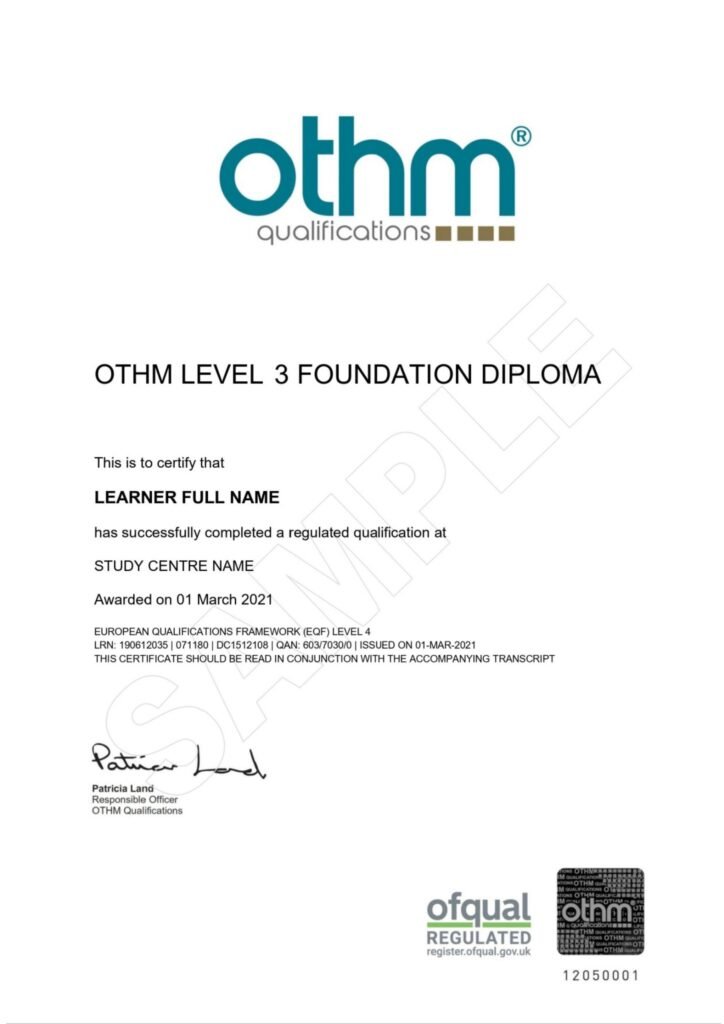
Certificate Sample